
In underground direct burial, coastal, tunnel, mine, and utility tunnel environments, moisture intrusion is the main cause of insulation aging, water tree growth, partial discharge, and breakdown. Ordinary cables only rely on the outer sheath for basic waterproofing. Once the sheath is damaged or water enters joints, moisture spreads rapidly along the cable, causing large-scale failures. Water-blocking cables use special structures and materials to prevent radial and longitudinal water migration, greatly improving reliability and service life in humid and submerged conditions.
Water-blocking cables are special power cables that use water-swellable materials and multi-layer sealing structures to prevent moisture penetration and longitudinal water propagation. Unlike ordinary waterproof cables, they can block water flow instantly even if the outer sheath is damaged.
Typical models include Covered Conductors Type CCT and N2XS(FL)2Y, widely used in underground, coastal, and humid power distribution systems.
Water enters from outside through damaged sheaths, aging, corrosion, or mechanical cracks.
Water flows along the cable length through joints, terminations, gaps, or capillary channels. This is the most destructive failure mode.
Water-Swellable Mechanism: Superabsorbent polymers (SAP) expand 20–100 times when wet, forming a dense gel to block gaps.
Longitudinal Blocking: Swellable yarns, tapes, and powders stop water from spreading along the cable.
Radial Blocking:Metallic and polymer sheaths prevent external moisture penetration.
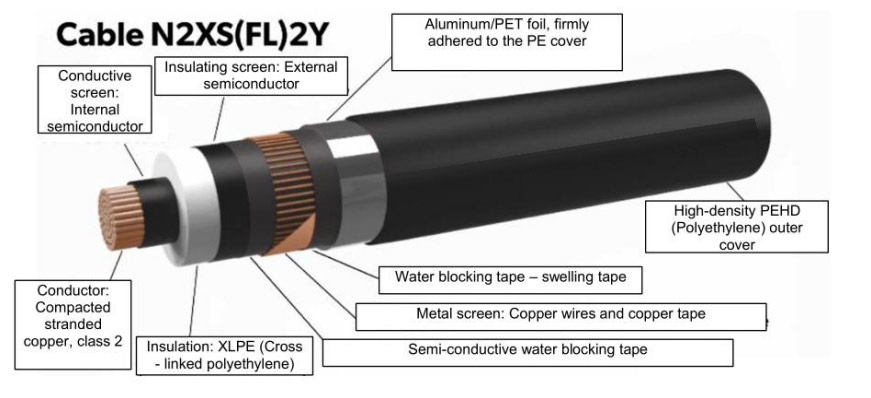
Conductor:Annealed copper, compacted stranding, with water-swellable yarn inside.
Conductor Screen:Semi-conductive layer for electric field uniformity.
Insulation:TR-XLPE (Tree Retardant XLPE) for excellent water-tree resistance.
Insulation Screen:Semi-conductive layer to stabilize electric field.
Water-Blocking Layer:Swellable tapes or fillers between cores.
Metallic screen: Copper wire and copper tape
Water blocking tape: Swelling tape
Metallic Sheath:Aluminum laminate longitudinally sealed (FL type in N2XS(FL)2Y).
Outer Sheath:HDPE or MDPE with low water absorption and high mechanical strength.
Water-Swellable Materials:Sodium polyacrylate, high expansion, non-toxic, gel-forming.
TR-XLPE:Resists water trees, stable in humid environments.
Semi-Conductive Shields:Co-cured with insulation, no gaps.
HDPE/MDPE:Durable,corrosion-resistant, low water absorption.
1.Conductor stranding with water-swellable yarn
2.Triple-layer co-extrusion (screen/insulation/screen)
3.Cabling with swellable tapes
4.Metallic sheath longitudinal sealing
5.HDPE/MDPE sheathing
6.Testing: voltage, partial discharge, water-blocking
N2XS(FL)2Y:European standard MV cable with longitudinal water-blocking metallic sheath.
Covered Conductors Type CCT:Overhead/burial cable with water-blocking and UV resistance.
Stops longitudinal water propagation
Resists water/electrical treeing
High reliability
Long service life
Low maintenance
Stable electrical performance
Underground grids, direct burial, coastal projects, tunnels, mines, offshore wind, industrial plants
Water-blocking cables use water-swellable materials and multi-layer structures to solve radial and longitudinal water intrusion. They greatly improve stability and lifespan in humid environments. Models like N2XS(FL)2Y and Covered Conductors Type CCT are widely used in medium-voltage systems and play an essential role in modern power networks.
